
An hour rating is a test result, not a paint thickness
When a fire safety plan asks for a 2-hour frame, it means the beam or column must still carry its load after 120 minutes in a standard furnace fire. The coating is only the means of getting there: its thickness is chosen afterwards, for each member, from the product's tested data.
Reading certificates written for other countries
Philippine plans usually state hours, as in US practice. Most coating certificates come from Europe, the US or Australia, so the same duration appears in different notation:
| Philippine plan / US | Europe (EN 13501-2) | Australia (FRL) |
|---|---|---|
| 1 hour | R 60 | 60/–/– |
| 2 hours | R 120 | 120/–/– |
| 3 hours | R 180 | 180/–/– |
Equal minutes do not make certificates interchangeable. Your fire protection engineer confirms which test evidence is accepted for the project.
Who sets the hours
The fire protection engineer derives them from RA 9514 and the National Building Code: occupancy, type of construction, building height, floor area and whether sprinklers are installed. The BFP checks the result when it issues the FSEC. Different members can carry different ratings, and some may need none.
Why three hours is far more than three times one hour
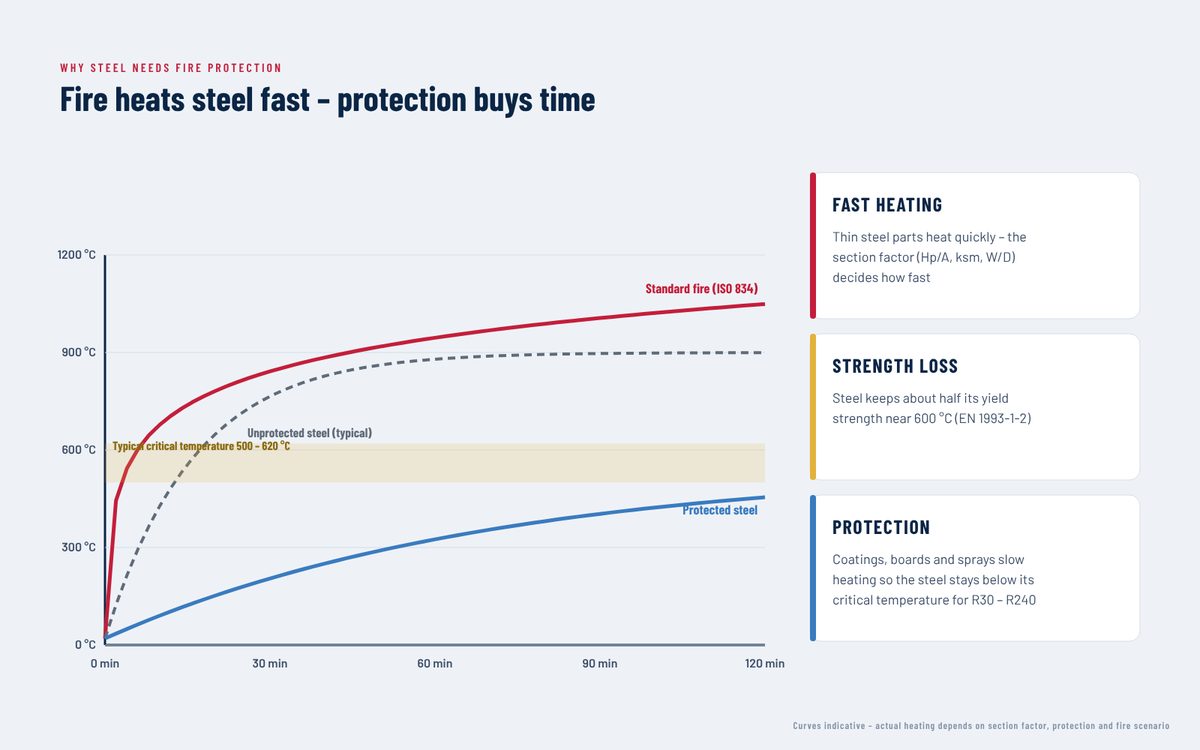
Steel heats faster as the fire goes on, so the coating needed grows faster than the time. On a slender beam a 2-hour rating can need several times the 1-hour film, and some thin-film products are not tested to 3 hours at all. For long ratings we compare intumescent with cementitious spray or boards before recommending a system.
FAQ
Is a 1-hour rating the same as R60?
Both describe 60 minutes, but they come from different test standards. Use the certificate route your engineer accepts.
Do roof purlins need fireproofing?
Usually not, unless the fire safety plan rates the roof structure. Ratings normally apply to columns, main beams and floor framing.
Preliminary calculations are provided for estimation purposes only. Final coating thickness and fire protection system selection must be verified against the approved product documentation, applicable project requirements and relevant engineering assessments.